
Executive Summary
Organizations have spent decades building functions dedicated to managing revenue, people, finance, and customer experience. Yet one of the most important drivers of business performance remains largely unmanaged: communication.
As workplaces become more distributed and AI generated communication becomes the norm, communication is no longer just a skill. It is an operational challenge. The organizations that learn to measure, govern, and improve communication at scale will gain a significant advantage in productivity, customer experience, and execution. This is where Communication Operations enters the conversation.

Communication Is No Longer Just a Soft Skill
Think about the average workday.
An employee starts the morning by responding to emails. They attend meetings, send messages on Teams or Slack, update tickets, write reports, collaborate with colleagues, interact with customers, and document decisions.
Communication is not a side activity. Communication is the work.
Research consistently shows that poor communication remains one of the leading causes of project delays, workplace conflict, employee disengagement, and customer dissatisfaction. Yet most organizations continue to treat communication as an individual competency rather than an organizational system.
That distinction matters.
Organizations do not leave revenue generation to chance. They build Revenue Operations.
They do not leave talent management to chance. They build People Operations.
So why do they leave communication to chance?
The answer is largely historical. Communication has always been viewed as a human skill that could be improved through hiring, training, and managerial coaching.
That assumption is becoming increasingly difficult to sustain.
The Workplace Has Changed Faster Than Communication Management
Several workplace shifts are exposing the limitations of traditional approaches.
Global Teams Have Become the Norm
Organizations are increasingly operating across countries, languages, cultures, and time zones.
A customer support team in Manila may support customers in Australia.
A product manager in London may collaborate with engineers in Bangalore.
A sales representative in New York may work with colleagues across three continents.
Communication is now occurring across far more variables than most organizations were designed to handle.
Work Has Become Increasingly Asynchronous
The rise of remote and hybrid work means employees cannot rely on immediate clarification.
Instructions must be clearer.
Documentation must be stronger.
Expectations must be explicit.
The quality of communication increasingly determines the speed of execution.
AI Has Changed the Communication Landscape
Perhaps the most significant shift is the rapid adoption of generative AI.
Employees can now produce polished emails, reports, summaries, proposals, customer responses, and presentations in seconds.
On the surface, this appears to solve communication challenges.
In reality, it creates new ones.
AI can improve grammar.
AI can improve structure.
AI cannot guarantee accuracy, judgment, context, empathy, or strategic thinking.
As communication becomes easier to generate, organizations face a different challenge: ensuring communication remains effective.
The problem is no longer communication volume.
The problem is communication quality.
Every Business Function Has an Operating System. Communication Does Not.
Consider how modern organizations manage critical business capabilities.
Sales teams have Sales Operations.
Customer success teams have Customer Operations.
Marketing teams have Marketing Operations.
Human Resources has People Operations.
Each function has processes, metrics, governance, technology, and accountability.
Communication, despite influencing every function, often lacks the same operational discipline.
Instead, communication responsibilities are scattered.
Human Resources owns internal messaging.
Learning and Development owns communication training.
Customer Experience manages customer interactions.
Operations manage documentation.
Marketing manages external communications.
The result is fragmentation.
No one owns communication as a business capability.
No one measures it consistently.
No one governs it strategically.
This gap is becoming increasingly visible.
What is Communication Operations?
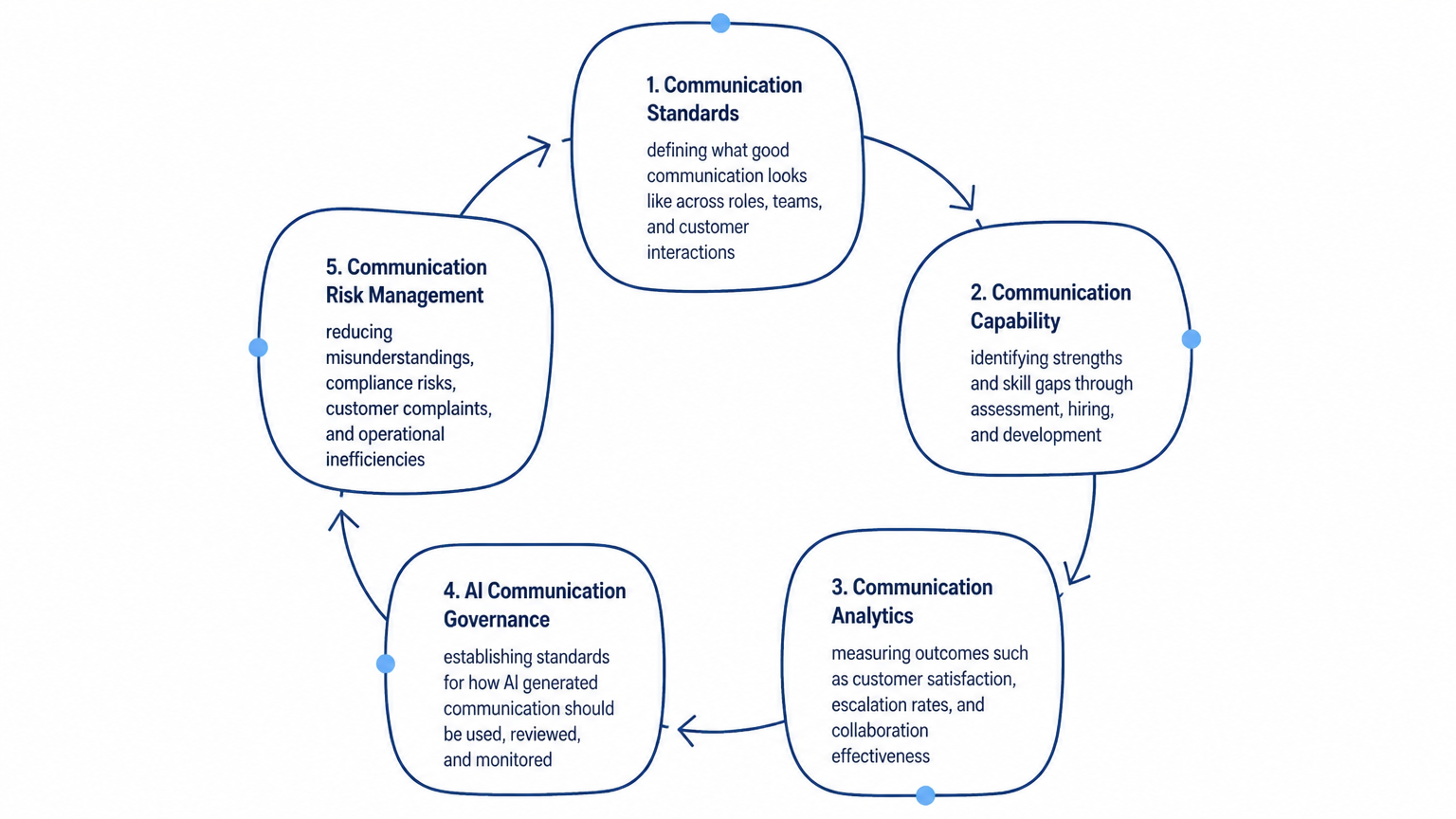
Communication Operations, or CommOps, is the systematic management of communication across an organization.
Its purpose is not to control how employees communicate.
Its purpose is to ensure communication supports business performance.
A Communication Operations function would focus on five core areas.
The Hidden Cost of Poor Communication
The business case for Communication Operations becomes clearer when organizations examine the cost of communication failures.
Poor communication rarely appears as a line item on a financial statement.
Its impact appears elsewhere.
- In rework.
- In delayed decisions.
- In customer escalations.
- In employee turnover.
- In lost productivity.
- In missed opportunities.
A study by global consulting firms has repeatedly shown that communication challenges become more expensive as organizations grow. The larger and more distributed the workforce, the greater the cost of ambiguity.
Every unclear instruction creates friction.
Every misunderstood customer interaction creates risk.
Every poorly documented process creates inefficiency.
Communication failures are often operational failures in disguise.
The Rise of Communication Intelligence

The next evolution of organizational communication will not simply focus on communication skills.
It will focus on communication intelligence.
Leading organizations are already beginning to ask new questions.
Which teams experience the highest communication related escalations?
Where are communication breakdowns affecting customer satisfaction?
How does communication quality influence employee performance?
What communication capabilities are most predictive of success?
How should AI generated communication be monitored?
These are not training questions.
They are operational questions.
And operational questions require operational ownership.
What Communication Operations Might Look Like in Practice
Few organizations will create a Chief Communication Operations Officer tomorrow.
More likely, Communication Operations will emerge as a cross functional capability.
Human Resources, Learning and Development, Operations, Customer Experience, and Analytics teams will work together to create communication standards and measurement frameworks.
Over time, organizations may establish dedicated Communication Operations teams responsible for:
- Communication capability assessments
- Communication quality metrics
- AI communication governance
- Customer communication standards
- Leadership communication effectiveness
- Workforce communication analytics
The organizations that adopt these practices early will be better positioned to navigate an increasingly complex communication environment.
The Future of Work Will Be Defined by Communication Quality
For years, organizations viewed communication as a soft skill.
The future workplace will view communication as infrastructure.
Just as companies invest in systems that manage revenue, customers, and talent, they will increasingly invest in systems that manage communication.
The rise of artificial intelligence makes this shift even more urgent.
As communication becomes easier to produce, it becomes harder to evaluate.
As communication volume increases, communication quality becomes more valuable.
And as organizations become more distributed, communication becomes one of the few capabilities that influences every employee, every customer, and every business outcome.
The question is no longer whether communication matters.
The question is whether organizations are prepared to manage it with the same discipline they apply to every other critical business function.
The companies that answer that question first may gain one of the most overlooked competitive advantages of the next decade.
Contact Us
For partnerships, enterprise licensing, or government recognition, contact us at support@hallo.ai
Ready to improve your hiring process?
If you’re interested in automating your language assessment, please visit our website to learn more.