
For years, customer support leaders treated communication as a secondary hiring variable.
Technical knowledge mattered more. Process familiarity mattered more. Product expertise mattered more.
Communication was often reduced to a subjective interview impression.
“Seems confident.”
“Speaks well enough.”
“Should be fine with customers.”
That assumption is quietly becoming one of the most expensive operational blind spots in modern hiring.
Not because communication suddenly became important.
But because the nature of customer communication itself has fundamentally changed.
Customer support today operates inside an environment shaped by remote teams, multilingual customers, AI assisted interactions, rising customer expectations, and shrinking tolerance for poor service experiences.
In this environment, communication quality is no longer a soft skill.
It is operational infrastructure.
And many hiring systems are still evaluating it like it is a personality trait.
The consequence is not merely weaker interviews or awkward customer calls.
It shows up in escalating operational costs:
- longer onboarding cycles,
- inconsistent QA scores,
- increased ticket escalations,
- lower customer trust,
- agent burnout,
- and declining CSAT performance despite larger hiring volumes.
Most organizations are trying to solve these issues downstream through training, quality assurance, or workforce management.
The problem often starts much earlier.
At the hiring stage itself.
The Communication Problem Most Hiring Teams Cannot Measure Properly

There is a growing contradiction inside customer support recruitment.
Companies increasingly recognize communication as critical.
Yet most hiring systems still evaluate communication using methods designed for smaller, office based, locally sourced workforces.
The mismatch is becoming severe.
A recruiter conducting a fifteen minute interview is expected to evaluate:
- fluency,
- pronunciation,
- conversational clarity,
- listening ability,
- customer empathy,
- confidence,
- adaptability,
- and multilingual readiness.
At scale.
Often across hundreds or thousands of applicants.
This creates a dangerous dependency on surface level impressions.
Candidates who interview confidently are frequently perceived as stronger communicators than candidates who communicate clearly under operational conditions.
Those are not always the same thing.
In fact, many support leaders privately acknowledge a recurring frustration:
Some agents perform exceptionally during interviews but struggle during live customer interactions.
Others appear less polished initially but become highly effective customer facing employees.
Traditional hiring processes rarely distinguish between interview communication and operational communication.
That distinction is now becoming commercially significant.
Why Traditional Interviews Are Quietly Failing
Most customer support interviews are optimized for efficiency rather than accuracy.
Recruiters face immense hiring pressure:
- high attrition,
- aggressive hiring targets,
- multilingual workforce expansion,
- and increasing recruiter fatigue.
Under these conditions, interviews become compressed decision making environments.
Recruiters naturally rely on cognitive shortcuts:
- confidence,
- accent familiarity,
- conversational smoothness,
- resume quality,
- or perceived professionalism.
But customer communication performance is far more situational than most hiring systems acknowledge.
A candidate may sound articulate in a structured interview yet struggle with:
- frustrated customers,
- rapid speech variation,
- unclear audio conditions,
- emotional conversations,
- multitasking pressure,
- or real time comprehension.
The reverse also happens frequently.
Candidates with moderate interview confidence may perform exceptionally in structured customer conversations because they possess:
- listening discipline,
- communication consistency,
- patience,
- clarity under pressure,
- and adaptability.
Traditional interviews are poorly designed to measure those capabilities objectively.
This is becoming even harder as candidates increasingly use AI assistance before interviews.
Candidates now routinely use tools to:
- rehearse answers,
- refine grammar,
- improve written communication,
- simulate interview conversations,
- and generate polished responses.
As a result, many hiring systems are evaluating preparation quality rather than communication reliability.
That distinction matters enormously in customer support environments where operational consistency determines customer trust.
The Hidden Operational Cost of Communication Misjudgment
Most organizations underestimate how deeply communication quality affects operational performance.
Communication inconsistency rarely appears as a single visible failure.
Instead, it spreads quietly across multiple operational layers.
Longer Onboarding Time
Agents with weaker communication adaptability often require significantly longer ramp up periods.
Managers compensate with:
- additional coaching,
- increased shadowing,
- more QA interventions,
- and repeated escalation handling.
This slows workforce scalability.
Particularly for high growth BPO environments.
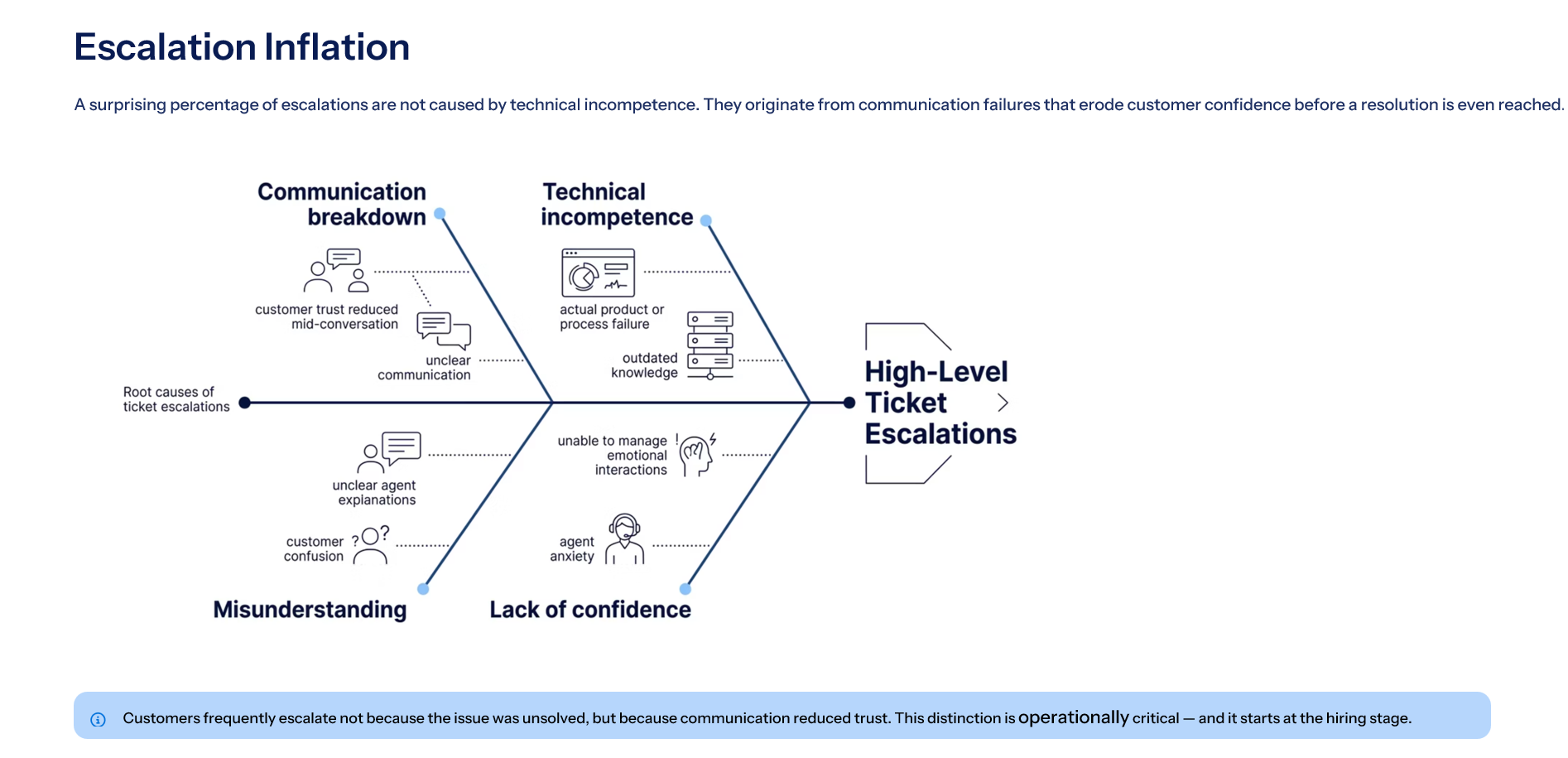
Customer Trust Erosion
Modern customers have become extremely sensitive to communication quality.
Not merely fluency.
Consistency.
Customers notice:
- hesitation,
- scripted responses,
- fragmented explanations,
- excessive filler language,
- or uncertainty.
Even technically correct interactions can create low trust experiences when communication lacks confidence and clarity.
Over time, this impacts:
- CSAT,
- retention,
- repeat purchase behavior,
- and brand perception.
Managerial Bandwidth Drain
Communication inconsistency creates hidden management overhead.
Supervisors spend disproportionate time:
- reviewing calls,
- resolving escalations,
- coaching soft skills,
- correcting misunderstandings,
- and managing customer dissatisfaction.
This reduces operational efficiency at scale.
Many organizations interpret these problems as training gaps.
Often, they are screening gaps.

The Emerging Workforce Shift Most Companies Have Not Fully Processed
Remote hiring fundamentally changed communication evaluation.
Before distributed hiring became common, organizations often recruited from geographically concentrated talent pools with familiar language patterns and communication expectations.
That environment no longer exists.
Today:
- support teams are globally distributed,
- multilingual interactions are increasing,
- accent diversity is expanding,
- and asynchronous communication is becoming normalized.
This creates a new hiring reality.
Communication quality can no longer be evaluated primarily through recruiter familiarity.
Yet many hiring systems still unconsciously reward:
- familiar accents,
- culturally aligned speech patterns,
- extroverted presentation styles,
- or polished interview personalities.
This introduces hidden bias into hiring decisions.
Ironically, some organizations unintentionally reject highly effective communicators because they do not match conventional interview expectations.
At the same time, global scaling pressures require faster hiring decisions with larger candidate pools.
Human evaluation alone struggles to maintain consistency under those conditions.
The result is growing hiring volatility.
Not because recruiters lack skill.
Because the evaluation environment itself has changed faster than hiring systems evolved.
Why Communication Assessment Is Becoming a Strategic Function
Historically, communication assessment was viewed as a screening layer.
That perception is shifting.
Forward looking organizations increasingly treat communication evaluation as a business performance function.
Because communication quality directly influences:
- operational scalability,
- customer loyalty,
- onboarding economics,
- workforce flexibility,
- and support consistency.
This changes how leading companies think about hiring.
The question is no longer:
“Can this candidate speak English well enough?”
The better question is:
“How consistently can this candidate communicate under real operational conditions?”
That requires more than resumes and interviews.
It requires measurable communication intelligence.
How AI Is Changing Communication Evaluation
AI based communication assessment is not valuable because it automates hiring.
Its real value is standardization.
AI creates the ability to evaluate communication patterns consistently across large candidate populations without depending entirely on recruiter subjectivity.
This becomes particularly powerful for:
- multilingual recruitment,
- remote hiring,
- BPO scaling,
- customer support expansion,
- and high volume workforce screening.
Modern AI communication assessments can evaluate:
- pronunciation clarity,
- fluency consistency,
- conversational pacing,
- listening comprehension,
- communication confidence,
- and role specific communication readiness.

More importantly, AI assessments create comparable evaluation frameworks.
This reduces variability between recruiters, locations, and hiring teams.
That consistency matters operationally.
Especially when organizations scale rapidly across regions.
The strongest hiring organizations are not replacing recruiters with AI.
They are reducing evaluation inconsistency with AI.
That is a very different strategic objective.
Where Hallo AI Fits Into the Shift
Hallo AI addresses a growing problem many hiring teams are already experiencing but struggle to quantify.
Communication evaluation does not scale efficiently through traditional interviews alone.
Particularly for:
- multilingual hiring,
- remote recruitment,
- BPO expansion,
- customer support scaling,
- and global workforce operations.
Hallo AI enables organizations to assess:
- spoken communication,
- pronunciation,
- fluency,
- conversational readiness,
- and language proficiency through AI driven assessments designed for operational hiring environments.
The advantage is not merely speed.
It is consistency.
Instead of relying entirely on recruiter interpretation, organizations gain structured communication insights that support:
- better hiring decisions,
- faster screening,
- improved workforce quality,
- and more scalable hiring operations.
For hiring leaders, this creates a meaningful shift.
Communication assessment becomes measurable infrastructure rather than subjective judgment.
What Smart Hiring Teams Will Do Differently Over the Next Three Years
Several workforce trends are accelerating simultaneously:
- AI assisted candidate preparation,
- global talent distribution,
- multilingual support expansion,
- recruiter fatigue,
- and rising customer experience expectations.
These forces are reshaping hiring economics.
Organizations that continue relying heavily on subjective communication evaluation may experience increasing inconsistency as hiring complexity grows.
The strongest hiring teams will likely move toward:
- structured communication assessment,
- role specific evaluation,
- scalable screening frameworks,
- and operationally aligned hiring metrics.
Communication quality will increasingly become tied to:
- customer retention,
- workforce scalability,
- onboarding efficiency,
- and support performance.
This is not simply a recruitment trend.
It is a workforce infrastructure shift.
And many organizations are still approaching communication hiring with assumptions built for a very different labor market.
Final Thoughts
The most significant hiring risks are often the least visible initially.
Communication misjudgment rarely appears immediately after recruitment.
It surfaces later:
- in escalations,
- customer frustration,
- inconsistent QA performance,
- extended onboarding,
- managerial overload,
- and declining trust metrics.
That is why many organizations underestimate its cost.
Customer support has entered an era where communication quality is operationally inseparable from customer experience itself.
Hiring systems need to evolve accordingly.
Not by eliminating human judgment.
But by strengthening it with better evaluation frameworks, structured communication analysis, and scalable assessment models.
The organizations that recognize this early may gain a substantial advantage in workforce quality, customer experience consistency, and global hiring scalability.
Contact Us
For partnerships, enterprise licensing, or government recognition, contact us at support@hallo.ai
Ready to improve your hiring process?
If you’re interested in automating your language assessment, please visit our website to learn more.