
Every growing company tracks financial debt.
Mature technology organizations track technical debt.
Yet almost no organization tracks a third category of liability that silently compounds across customer support teams, shared service centers, BPO operations, multilingual operations, and distributed workforces.
Communication debt.
Unlike financial debt, it never appears on a balance sheet.
Unlike technical debt, it rarely appears on a roadmap.
Instead, it surfaces in places leaders often treat as unrelated operational problems.
It appears in customer escalations.
It appears in repeat coaching sessions.
It appears in onboarding programs that seem longer every year.
It appears when managers spend excessive time clarifying instructions.
It appears when otherwise capable employees struggle to reach productivity targets.
Most organizations assume these issues originate from training gaps, management inefficiencies, or workforce quality challenges.
Increasingly, they are symptoms of the same underlying problem.
Communication debt.
And for organizations scaling rapidly, it may be one of the most underestimated operational risks of the next decade.
The Hidden Workforce Problem Most Organizations Never Measure
When executives discuss workforce quality, they typically focus on measurable indicators:
- Time-to-fill
- Cost-per-hire
- Attrition
- Productivity
- Customer satisfaction
- Quality assurance scores
Communication capability is usually treated as an input rather than an outcome driver.
The assumption is simple:
“If candidates pass interviews and complete onboarding, communication is probably good enough.”
That assumption worked when hiring volumes were lower, teams were co-located, and customer interactions were relatively standardized.
Those conditions no longer exist.
Today’s workforce operates across:
- Multiple languages
- Distributed teams
- Remote environments
- AI-assisted workflows
- Global customer bases
- Digital-first communication channels
As complexity increases, communication quality becomes a multiplier.
Strong communication amplifies performance.
Weak communication amplifies friction.
The challenge is that friction accumulates slowly.
Organizations rarely notice the problem during hiring.
They notice it six months later in operational metrics.
By then, communication debt has already started compounding.
Communication Debt Accumulates the Same Way Technical Debt Does

Technical debt emerges when organizations choose expediency over long-term system quality.
Communication debt follows a remarkably similar pattern.
A hiring manager fills a role quickly because staffing targets are urgent.
A recruiter relies on interview impressions because formal assessment feels unnecessary.
A candidate demonstrates confidence but not necessarily clarity.
A team assumes communication skills can be developed later.
None of these decisions seem problematic in isolation.
The problem emerges when the pattern repeats hundreds or thousands of times.
Over time, organizations accumulate employees whose communication capabilities sit just above hiring thresholds but below operational requirements.
The consequences are subtle at first.
Managers repeat instructions.
Training sessions require additional reinforcement.
Customer conversations take longer.
Quality monitoring identifies recurring communication issues.
Escalations increase.
Customer trust weakens.
What appears to be a collection of disconnected inefficiencies is often a single systemic liability.
Communication debt.
Why Traditional Hiring Methods Miss the Problem
One reason communication debt remains invisible is because traditional hiring processes were never designed to measure it.
Most hiring systems evaluate communication through proxy signals:
- Resume quality
- Educational background
- Interview confidence
- Conversational fluency
- Recruiter perception
These indicators create an illusion of predictability.
Unfortunately, they often measure performance during evaluation rather than performance during work.
The distinction matters.
A candidate who communicates effectively during a structured interview may struggle in:
- High-pressure customer interactions
- Multitasking environments
- Cross-functional collaboration
- Difficult escalation scenarios
- Complex multilingual conversations
Modern interviews frequently reward confidence.
Operations require consistency.
Those are not always the same thing.
This gap has become even more pronounced as candidates increasingly use AI tools to prepare for interviews, refine responses, and rehearse common questions.
As preparation quality rises, interview performance becomes a less reliable predictor of workplace communication effectiveness.
Organizations may believe they are improving hiring quality when they are actually increasing hiring ambiguity.
The Operational Cost Nobody Calculates
Communication debt creates expenses that rarely appear under a single budget category.
Instead, costs become distributed across departments.
Training teams experience it through longer onboarding cycles.
Operations teams experience it through increased supervision requirements.
Customer support leaders experience it through lower CSAT and higher escalation rates.
HR teams experience it through performance management complexity.
Finance teams experience it through declining operational efficiency.
Consider a customer support organization hiring 500 representatives annually.
If communication gaps add only five extra days to onboarding per employee, the organization absorbs thousands of additional training hours every year.
If communication inconsistencies increase average handling time by even a small margin, labor costs compound rapidly.
If customer misunderstandings create additional escalations, customer experience deteriorates while support costs increase simultaneously.
None of these outcomes appear on a hiring dashboard.
Yet all of them originate from hiring decisions.
Communication debt transforms recruitment quality into operational expense.
The Contradiction in Modern Hiring
Organizations have never invested more in sourcing talent.
Yet many invest surprisingly little in verifying how effectively talent can communicate once hired.
This contradiction is becoming increasingly difficult to justify.
Recruiters scrutinize:
- Experience
- Certifications
- Technical competencies
- Educational credentials
Meanwhile, communication the mechanism through which all other skills are delivered often receives a relatively subjective evaluation.
Imagine hiring a customer support representative based solely on a resume review and a brief conversation.
Now compare that to the rigor organizations apply when evaluating technical competencies.
The imbalance becomes obvious.
Communication remains one of the few mission-critical skills that many organizations still assess informally despite its direct impact on customer outcomes.
A Workforce Trend Leaders Are Underestimating
The next major workforce challenge may not be automation.
It may be communication variance.
As organizations expand globally, they gain access to larger talent pools.
This creates enormous opportunity.
It also creates greater variation in communication styles, language proficiency, pronunciation, conversational confidence, and customer interaction readiness.
Historically, managers absorbed these differences through direct supervision.
That model becomes unsustainable at scale.
A workforce of 100 employees can rely on manager intervention.
A workforce of 10,000 cannot.
The larger organizations become, the more communication consistency becomes a strategic capability rather than an individual skill.
Companies that fail to standardize communication evaluation may find themselves scaling headcount faster than they scale workforce effectiveness.
Communication Debt and Customer Experience Are More Connected Than Leaders Realize
Most customer experience initiatives focus on technology, workflows, and service processes.
Communication quality often remains a secondary consideration.
Yet customers experience organizations primarily through conversations.
Not dashboards.
Not internal metrics.
Not process maps.
Conversations.
Every unclear explanation, misunderstood request, or awkward interaction creates friction.
Over time, these moments shape customer perception.
When communication quality varies significantly across teams, customer experience becomes unpredictable.
Customers may receive excellent service from one representative and confusing service from another.
The result is inconsistency.
And inconsistency is often more damaging than average performance.
The organizations that consistently outperform on customer satisfaction tend to recognize a simple reality:
Communication quality is customer experience quality.
How AI Is Changing the Economics of Evaluation
For decades, communication assessment faced a practical limitation.
It was difficult to evaluate consistently at scale.
Human interviews are subjective.
Recruiter observations vary.
Assessment standards differ across locations and teams.
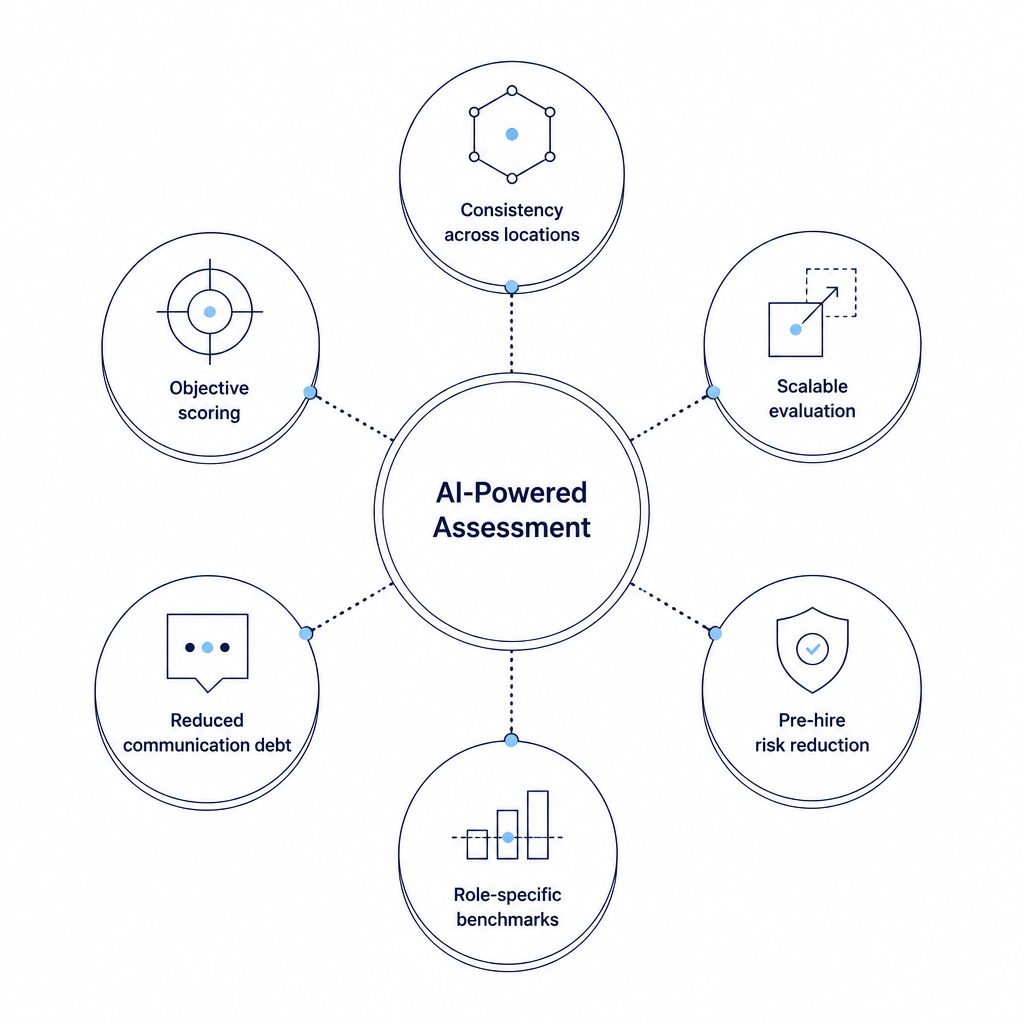
AI changes this equation.
Not because it replaces recruiters.
Because it introduces measurement consistency.
Organizations can now evaluate dimensions that were historically difficult to standardize, including:
- Pronunciation
- Fluency
- Spoken language proficiency
- Conversational confidence
- Communication clarity
- Role-specific communication readiness
More importantly, these evaluations can occur before hiring decisions are made.
This shifts communication assessment from reactive correction to proactive risk management.
The question becomes:
How much communication debt can be prevented before it enters the organization?
That is a fundamentally different conversation than simply asking whether a candidate speaks English well.
From Language Testing to Communication Intelligence
Forward-thinking organizations are beginning to rethink assessment entirely.
Rather than asking:
“Can this candidate communicate?”
They are asking:
“How will this candidate’s communication capability influence business outcomes?”
That distinction matters.
Communication assessment is evolving from a screening exercise into a predictive workforce intelligence function.
Organizations increasingly want to understand:
- Who will reach productivity fastest?
- Who will require additional coaching?
- Who is customer-ready today?
- Who can effectively support global customers?
- Where are communication risks likely to emerge?
The organizations that answer these questions accurately gain a significant operational advantage.
Where Hallo AI Fits Into the Future of Workforce Quality
The most valuable hiring technologies are not those that simply automate decisions.
They are those that improve decision quality.
Hallo AI helps organizations evaluate communication with greater consistency, objectivity, and scale.
Instead of relying solely on interview impressions, hiring teams gain structured insights into spoken language proficiency, pronunciation, fluency, conversational confidence, and role readiness.
This creates benefits that extend far beyond recruitment.
Better communication assessment supports:
- Faster onboarding
- Reduced coaching requirements
- Improved customer interactions
- Higher workforce consistency
- Better quality assurance outcomes
- Stronger operational scalability
Most importantly, it helps organizations reduce communication debt before it enters the workforce.
Five Questions Every Hiring Leader Should Ask
Before your next hiring cycle, consider these questions:
- Which operational metrics are most influenced by communication quality?
- How consistently do recruiters evaluate communication today?
- Where does communication-related coaching consume manager time?
- What percentage of customer escalations can be traced to misunderstandings?
- If communication quality improved by 10%, which business outcomes would improve first?
The answers often reveal opportunities that traditional hiring metrics overlook.
The Next Competitive Advantage Isn’t More Hiring. It’s Better Communication Signals
For years, organizations competed by acquiring talent faster.
The next phase of workforce strategy may focus on understanding talent more accurately.
As hiring volumes grow and candidate pools become increasingly global, communication quality will become a more important predictor of operational performance.
Companies that continue treating communication assessment as a recruitment checkbox may unknowingly accumulate communication debt year after year.
Those that treat communication as a measurable business capability will build more scalable teams, more consistent customer experiences, and more resilient operations.
Technical debt shaped the last generation of business transformation.
Communication debt may shape the next.

The organizations that recognize it early will gain an advantage long before their competitors realize the liability exists.
Contact Us
For partnerships, enterprise licensing, or government recognition, contact us at support@hallo.ai
Ready to improve your hiring process?
If you’re interested in automating your language assessment, please visit our website to learn more.