
Five years ago, seeing a CEFR B2 score on a candidate profile gave recruiters a reasonable sense of what to expect.
The candidate could participate in meetings.
Handle workplace communication.
Manage customer conversations with moderate confidence.
Write professional emails.
Express opinions clearly.
The score was not perfect, but it was generally predictive.
Today, that assumption is becoming increasingly unreliable.
Not because the CEFR framework is flawed.
Not because language assessments are losing relevance.
But because the environment surrounding language acquisition has fundamentally changed.
A growing number of hiring teams are discovering something surprising.
Candidates with identical CEFR levels often perform very differently in real workplace situations.
Some thrive in customer interactions.
Others struggle.
Some communicate naturally under pressure.
Others become hesitant when conversations move beyond familiar territory.
Some navigate global business environments confidently.
Others struggle despite having the same certification level.
The result is a phenomenon that few organizations are discussing but many are beginning to experience.
Language inflation.
And it may become one of the most important challenges facing global hiring over the next decade.
What Is Language Inflation?

In economics, inflation occurs when a currency gradually loses purchasing power.
The number stays the same.
Its meaning changes.
A similar shift is beginning to occur in language assessment.
The label remains constant.
The underlying capability varies more widely than before.
A B2 designation still exists.
But the path candidates take to reach B2 has evolved dramatically.
The learning environment has changed.
The tools have changed.
The exposure has changed.
And increasingly, the practical communication ability behind the score has changed as well.
This does not mean language standards have declined.
It means the relationship between certification and workplace performance is becoming more complex.

The Globalization Effect Nobody Predicted
For years, globalization expanded access to English language learning.
This was overwhelmingly positive.
More people gained access to education.
More professionals entered international labor markets.
More organizations could recruit talent globally.
However, globalization also created a new challenge.
Millions of candidates now learn English in environments that differ significantly from traditional immersion-based learning.
Many acquire language through:
- Online courses
- Video content
- Test preparation platforms
- Social media
- AI powered learning tools
- Virtual classrooms
- Digital exercises
These methods often produce strong academic language skills.
Yet workplace communication requires something different.
- Negotiation.
- Clarification.
- Conflict resolution.
- Listening under pressure.
- Managing ambiguity.
- Handling unfamiliar accents.
- Building trust.
These skills develop through interaction rather than instruction.
As a result, two candidates with the same CEFR score may possess dramatically different workplace communication capabilities.
Why CEFR Scores Alone Are Becoming Less Predictive
The CEFR framework remains one of the most valuable language standards in the world.
The challenge is not the framework itself.
The challenge is how employers interpret it.
Many hiring teams treat CEFR scores as fixed indicators of workplace readiness.
In reality, CEFR measures language proficiency.
It does not fully measure workplace communication performance.
Consider two candidates who both achieve B2.
Candidate A learned English through years of customer interactions, international collaboration, and practical workplace exposure.
Candidate B achieved B2 primarily through structured learning and examination preparation.
Both legitimately qualify as B2.
Yet their ability to handle real world communication may differ significantly.
The issue is not accuracy.
The issue is interpretation.
Recruiters often assume language proficiency and workplace communication are interchangeable.
Increasingly, they are not.
The Rise of Assessment Optimization

Another factor contributing to language inflation is candidate adaptation.
As global hiring becomes more competitive, candidates become increasingly sophisticated.
They learn how assessments work.
They identify common patterns.
They optimize preparation strategies.
Entire industries now exist around helping candidates improve test performance.
This is not unique to language assessment.
It occurs across education, certification, and recruitment.
However, language testing faces a unique challenge.
The objective is not merely knowledge acquisition.
It is communication capability.
Candidates can become highly effective at demonstrating proficiency within predictable assessment environments.
Yet real workplace communication is rarely predictable.
Customers interrupt.
Conversations change direction.
Accents vary.
Information is incomplete.
Context evolves rapidly.
Success depends on adaptability as much as language knowledge.
Why BPOs Are Feeling the Impact First
The language inflation phenomenon becomes particularly visible in customer facing roles.
A support representative may possess strong reading and writing skills.
Yet struggle with live customer conversations.
A candidate may perform exceptionally during a structured assessment.
Yet find it difficult to navigate emotional customer interactions.
A multilingual employee may understand English perfectly.
Yet struggle with communication speed during real time conversations.
This creates a costly hiring challenge.
Organizations recruit based on language credentials.
Performance depends on communication execution.
The gap between the two becomes increasingly important as hiring volumes increase.
Many BPOs are already experiencing this disconnect.
They are hiring candidates who technically meet language requirements but require longer onboarding periods before reaching full productivity.
The Hidden Cost of Language Inflation
The consequences extend beyond hiring mistakes.
Language inflation creates operational inefficiencies throughout the employee lifecycle.
Longer training periods.
Higher coaching requirements.
Lower customer satisfaction.
Increased quality assurance interventions.
Higher attrition during onboarding.
Reduced first call resolution rates.
Most organizations attribute these challenges to training.
Some may actually originate during candidate selection.
When language benchmarks become less predictive of workplace performance, hiring risk increases.
Organizations believe they are hiring communication ready talent.
In reality, they may be hiring language ready talent.
The distinction matters.
The Future of Language Assessment

The solution is not abandoning language assessments.
In fact, language assessments are becoming more important than ever.
But their role must evolve.
Organizations need to move beyond measuring language proficiency alone.
They need visibility into language application.
Future focused assessment strategies will increasingly evaluate:
Listening in realistic workplace contexts.
Spoken communication under pressure.
Comprehension across different accents.
Communication adaptability.
Interactive problem solving.
Workplace scenario performance.
The goal is not simply understanding whether candidates know the language.
It is understanding whether they can use the language effectively in the environments where they will work.
Why Global Hiring Teams Need a New Fluency Framework
One of the biggest mistakes organizations make is treating fluency as a binary concept. Fluent or not fluent. Qualified or not qualified.Reality is far more nuanced.
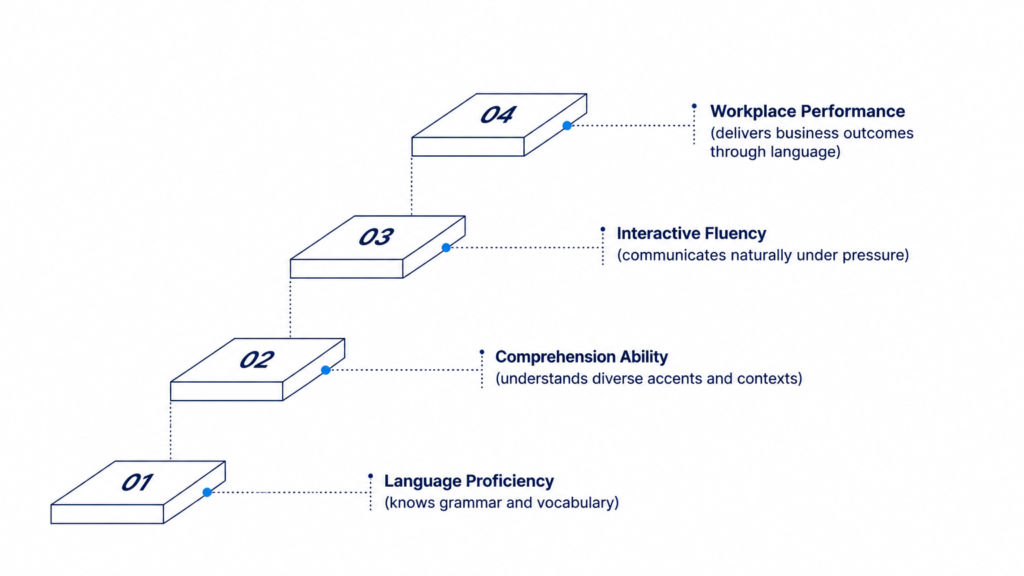
Two candidates with identical proficiency levels may deliver dramatically different business outcomes.
The organizations that recognize this early will gain a significant competitive advantage.
They will make better hiring decisions.
Reduce onboarding risk.
Improve customer experiences.
And build stronger global teams.

Where Hallo AI Fits into the Conversation
The language inflation crisis is not a failure of language assessment.
It is a signal that organizations need deeper insight into communication capability.
Hallo AI helps bridge that gap by evaluating language skills within contexts that reflect real workplace communication.
Rather than relying solely on static proficiency indicators, organizations can gain visibility into how candidates listen, respond, comprehend, and communicate in practical scenarios.
For global hiring teams, language schools, workforce development programs, and BPO leaders, this provides a more complete picture of candidate readiness.
Because the future of hiring is not simply about identifying who speaks a language.
It is about identifying who can perform in that language when business outcomes depend on it.
Final Thoughts
Five years ago, a CEFR score often told recruiters what they needed to know.
In 2026, the picture is more complicated.
The global workforce has changed.
Language learning has changed.
Candidate preparation has changed.
Work itself has changed.
The result is language inflation.
Not because language standards are weaker.
But because language proficiency alone no longer tells the whole story.
The organizations that adapt first will move beyond asking:
“What CEFR level does this candidate have?”
And begin asking:
“What can this candidate actually do with that language?”
That question may define the next generation of global hiring.
Call To Action
Is your organization hiring based on language scores or communication readiness?
Discover how modern language assessments can help you identify candidates who can perform effectively in real workplace situations.
Learn how Hallo AI helps global organizations move beyond proficiency and assess practical communication capability at scale.
Contact Us
For partnerships, enterprise licensing, or government recognition, contact us at support@hallo.ai
Ready to improve your hiring process?
If you’re interested in automating your language assessment, please visit our website to learn more.