
AI Has Created a New Type of Candidate and Most Hiring Teams Cannot Detect It
For years, recruiters were taught to look for confidence, polished communication, and fluent English as signals of competence.
Today, those signals are becoming dangerously unreliable.
A candidate can now walk into an interview with AI generated practice responses, real time grammar correction tools, speech enhancement software, and interview coaching prompts running quietly in the background. They can rehearse ideal answers with conversational AI for hours before speaking to a recruiter. Some candidates are even using live AI assistance during remote interviews without employers realizing it.
The result is a growing hiring illusion.
Recruiters believe they are evaluating communication ability. In reality, they are often evaluating a candidate’s ability to use AI tools effectively.
This shift is happening faster than most hiring teams realize.
While companies continue debating whether AI will replace jobs, a more immediate problem has already emerged. AI is reshaping candidate behavior itself. It is changing how people present confidence, fluency, professionalism, and competence during the hiring process.
This creates a major challenge for recruiters, especially in global hiring environments where communication quality directly impacts business outcomes.
Traditional interviews were never designed for AI enhanced candidates.
And most hiring systems are completely unprepared for what comes next.
The Rise of Artificial Professionalism
There was a time when strong grammar and polished interview answers were considered reliable indicators of communication ability.
That assumption no longer holds.
Modern AI tools can instantly rewrite sentences, improve vocabulary, soften accents in real time, and generate structured responses that sound thoughtful and articulate. Candidates who previously struggled to express ideas clearly can now appear highly polished during interviews and written assessments.
On the surface, this sounds positive. Better communication should improve employability.
But there is a deeper issue that companies are beginning to discover.
Professional sounding communication is no longer the same thing as genuine communication ability.
A candidate may sound fluent in an interview yet struggle to explain problems clearly during live customer interactions. Another candidate may produce perfectly structured written responses but fail to collaborate effectively inside multilingual teams.
The hiring process is increasingly rewarding presentation rather than communication substance.
This is particularly dangerous in customer facing industries such as BPOs, customer support, sales, hospitality, healthcare recruitment, and global remote operations where communication clarity directly affects customer trust and operational efficiency.
In these environments, employers are not simply hiring people who can speak English well. They are hiring people who can navigate ambiguity, explain issues clearly under pressure, adapt tone appropriately, and communicate naturally across cultures.
AI can improve surface level fluency.
It cannot fully replicate authentic human communication under real workplace conditions.
Why Traditional Interviews Are Quietly Failing
Most interviews today still rely heavily on predictable formats.
“Tell me about yourself.”
“What are your strengths?”
“Describe a difficult situation.”
Candidates know these questions in advance. AI knows them too.
Entire ecosystems now exist around optimizing interview performance using AI generated scripts and coaching systems. Candidates can simulate interviews endlessly and memorize highly polished frameworks that sound impressive but reveal very little about real workplace communication ability.
This creates a growing mismatch between interview performance and job performance.
Recruiters are starting to notice it.
Some employees who perform exceptionally well during interviews later struggle in collaborative environments. Others demonstrate strong written fluency during hiring but fail in live customer conversations where spontaneity matters.
The issue is not dishonesty.
It is that hiring systems are measuring the wrong thing.
Many traditional assessments still focus heavily on grammar accuracy, vocabulary sophistication, or rehearsed responses. But modern workplaces require something more dynamic.
Real communication includes:
Context awareness
Adaptability
Listening skills
Clarification ability
Emotional intelligence
Response under pressure
Cross cultural comprehension
Natural conversation flow
These are far harder for AI to artificially optimize during assessments.
Ironically, as AI improves language polishing, human authenticity becomes more valuable.
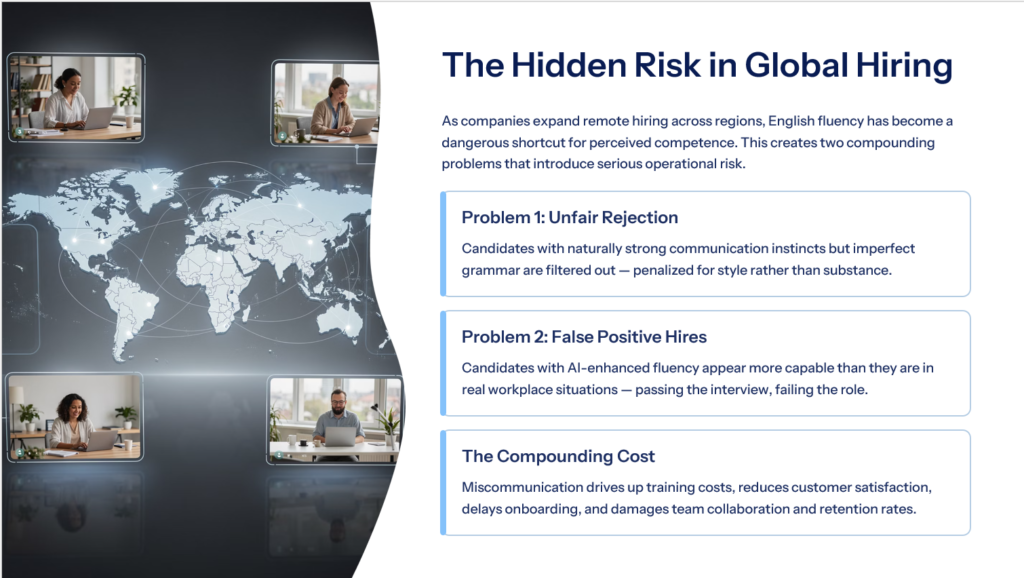 The impact becomes even more significant in international recruitment.
This creates two major problems.
First, candidates with naturally strong communication instincts but imperfect grammar may be unfairly rejected.
Second, candidates with AI enhanced fluency may appear more capable than they actually are in real workplace situations.
This creates hidden operational risks.
Imagine a customer support agent who performs well during interviews because AI helped refine their communication style beforehand. Once hired, they struggle with spontaneous customer escalation calls where real time thinking and emotional clarity matter more than polished wording.
Or consider remote teams where employees can write flawless AI assisted emails but struggle during live collaborative discussions.
The cost of these hiring mismatches compounds quickly.
Miscommunication affects customer satisfaction, training costs, onboarding efficiency, team collaboration, and employee retention.
Yet many organizations continue using assessment systems built for a pre-AI hiring market.
That gap is widening every month.
The Future of Hiring Will Focus on Communication Authenticity
Over the next few years, hiring strategies will shift dramatically.
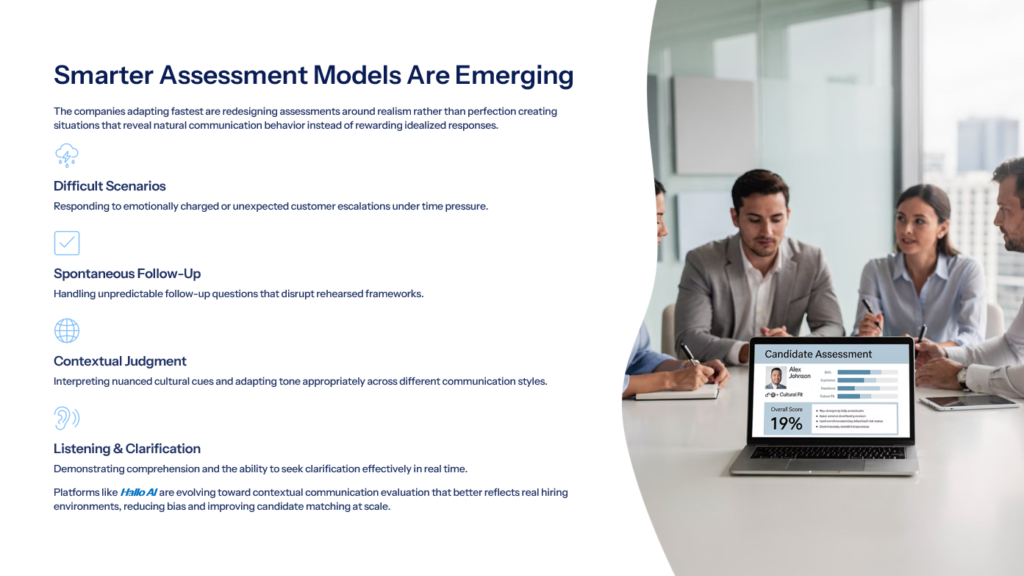
Companies will move away from evaluating static fluency and toward measuring authentic communication behavior.
This means recruiters will increasingly prioritize assessments that evaluate:
Real time responses
Spontaneous interaction
Scenario based communication
Problem solving conversations
Listening comprehension
Adaptive language use
Contextual communication judgment
The goal will no longer be identifying candidates who sound polished.
It will be identifying candidates who communicate effectively in unpredictable human situations.
This shift mirrors what happened in education.
When calculators became common, schools stopped evaluating students purely on manual arithmetic. Instead, they emphasized reasoning and application.
Hiring will undergo a similar transition.
As AI makes polished communication easier to manufacture, employers will place greater value on authenticity, adaptability, and practical communication intelligence.
Why This Matters for BPOs and Customer Facing Teams
Few industries will feel this shift more intensely than BPOs and multilingual customer support operations.
For these organizations, communication quality is directly tied to revenue, customer experience, and brand reputation.
A candidate who sounds excellent in scripted assessments but struggles during live customer interactions creates operational instability.
This is where many traditional language assessments fall short.
They often measure correctness rather than communication effectiveness.
But customer conversations are rarely predictable.
Agents must manage emotion, navigate misunderstandings, clarify intent, handle interruptions, and adapt tone instantly. These are deeply human communication skills that cannot be fully measured through static testing alone.
Forward thinking hiring teams are beginning to recognize this distinction.
They are moving toward more dynamic assessment models that evaluate practical communication behavior instead of rehearsed fluency alone.
The Emerging Divide Between Human Communicators and AI Assisted Performers
One of the most interesting shifts happening right now is the growing separation between candidates who genuinely communicate well and candidates who merely appear polished because of AI assistance.
At first glance, the difference can be subtle.
But over time, the gap becomes obvious in workplace performance.
Authentic communicators tend to:
Handle ambiguity better
Build trust faster
Navigate conflict naturally
Adapt communication styles effectively
Respond calmly under pressure
Clarify misunderstandings efficiently
Collaborate more smoothly across cultures
Meanwhile, AI dependent communicators may struggle once scripted structure disappears.
This does not mean AI assistance is inherently bad.
In many ways, AI is democratizing access to professional communication tools. It helps candidates improve confidence and reduce language anxiety.
But recruiters must recognize that AI enhanced fluency does not automatically equal communication readiness.
That distinction will become one of the defining hiring challenges of the next decade.
The Companies That Adapt First Will Hire Better Talent
Every technological shift changes hiring behavior.
LinkedIn changed resumes.
Remote work changed interviews.
AI is now changing candidate presentation itself.
The companies that continue using outdated evaluation methods will increasingly struggle with hiring mismatches, communication gaps, and inflated interview performance signals.
The companies that adapt early will gain a major advantage.
They will identify authentic communicators more effectively.
They will build stronger global teams.
And they will create hiring systems designed for the reality of the modern workforce rather than the assumptions of the past.
Because in the AI era, sounding professional is becoming easy.
Communicating effectively is still rare.
Want to assess real communication ability instead of rehearsed fluency?
Discover how Hallo AI helps global hiring teams evaluate authentic communication skills with smarter language and workplace assessments built for the modern hiring landscape.
Contact Us
For partnerships, enterprise licensing, or government recognition, contact us at support@hallo.ai
Ready to improve your hiring process?
If you’re interested in automating your language assessment, please visit our website to learn more.