
A hiring mistake rarely looks like a hiring mistake at first.
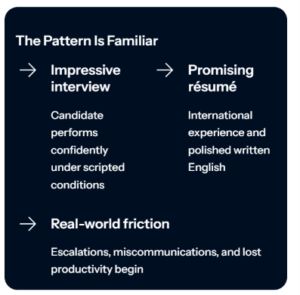
The candidate interviews well.
Their résumé looks impressive.
They’ve worked with international clients.
Their written English seems polished.
Three weeks later, customer escalations begin piling up.
A support agent misunderstands tone and frustrates clients.
A sales representative struggles during live calls.
Project updates become confusing across distributed teams.
Managers spend hours clarifying instructions that should have taken minutes.
The issue often isn’t technical ability.
It’s communication.
And most companies still underestimate how expensive communication gaps really are.
As global hiring accelerates, English fluency has quietly become one of the strongest predictors of operational efficiency, customer satisfaction, and team productivity. Yet many organizations continue relying on outdated hiring methods that fail to accurately measure real-world communication ability.
That gap creates hidden costs most hiring teams never calculate.
English Fluency Is No Longer a “Soft Skill”
For years, language proficiency was treated as secondary during hiring.
If a candidate had the right technical background, companies assumed communication skills would naturally follow. But global hiring has changed the rules.
Today, teams collaborate across:
- countries
- accents
- time zones
- cultures
- communication styles
In this environment, communication is infrastructure.
A developer explaining blockers.
A recruiter conducting interviews.
A customer support agent calming an upset client.
A virtual assistant coordinating schedules.
Every interaction shapes business performance.
Even small misunderstandings create friction that compounds over time.
The Real Business Cost of Poor Language Assessment
Most hiring teams measure recruitment costs in obvious ways:
- salary
- onboarding
- training
- recruitment spend
But the hidden operational costs are often much larger.
1. Customer Dissatisfaction
One unclear conversation can damage trust instantly.
In customer-facing roles, communication affects:
- response quality
- empathy
- confidence
- problem resolution speed
Customers rarely complain specifically about “language proficiency.”
Instead, they say:
- “The agent didn’t understand me.”
- “I had to repeat myself.”
- “The conversation felt frustrating.”
Companies often misdiagnose this as a process issue when the real problem is communication quality.
2. Productivity Loss Across Teams
Internal communication breakdowns are expensive.
Managers spend additional time:
- rewriting instructions
- clarifying tasks
- correcting misunderstandings
- reviewing incomplete work
Multiply that across hundreds of employees, and communication inefficiency becomes an operational tax.
A 10-minute misunderstanding repeated daily across teams can quietly consume thousands of work hours annually.
3. Failed Outsourcing Partnerships
Many outsourcing relationships fail for one reason nobody mentions early enough: communication mismatch.
A vendor may technically deliver the work, but collaboration becomes exhausting because:
- expectations are misunderstood
- feedback loops become slow
- tone creates friction
- meetings lack clarity
Eventually, trust deteriorates.
Companies often blame geography, culture, or process when the underlying issue is ineffective language evaluation during hiring.
4. Increased Training Costs
When communication gaps appear after hiring, companies compensate through:
- longer onboarding
- extra supervision
- remedial training
- repeated coaching
These hidden costs rarely appear in hiring reports.
But they directly affect profitability.
Why Traditional Hiring Methods Fail to Measure Communication Ability
The uncomfortable truth is this:
Most hiring processes are poor predictors of real-world communication.
Résumés Don’t Measure Conversation Skills
A candidate can write “fluent in English” on a résumé regardless of actual proficiency.
Certifications also create false confidence.
Many traditional English tests measure:
- memorization
- grammar rules
- vocabulary recall
But workplace communication is dynamic.
Employees need to:
- interpret tone
- respond naturally
- think under pressure
- explain ideas clearly
- navigate ambiguity
Multiple-choice exams rarely test these abilities effectively.
Interviews Are Surprisingly Inconsistent
Human interviews are heavily subjective.
One interviewer may prioritize accent clarity.
Another values confidence.
Another unconsciously favors familiar communication styles.
This inconsistency creates bias and unreliable hiring signals.
Candidates also prepare scripted interview answers that may not reflect real workplace communication.
A polished introduction does not necessarily mean someone can:
- handle customer objections
- explain technical issues
- participate in fast-moving discussions
- collaborate cross-functionally
The Difference Between “Knowing English” and Working in English
This distinction is becoming critical in global recruitment.
Resumes Do Not Measure Conversation
A candidate can write “fluent in English” on a resume
regardless of actual proficiency. Certifications create
false confidence because many traditional English
tests measure memorization, grammar rules, and
vocabulary recall. But workplace communication is
dynamic. Employees need to interpret tone, respond
naturally, think under pressure, explain ideas clearly,
and navigate ambiguity. Multiple-choice exams rarely
test these abilities effectively.
Interviews Are Surprisingly Inconsistent
Human interviews are heavily subjective. One
interviewer may prioritize accent clarity, another
values confidence, and another unconsciously favors
familiar communication styles. This inconsistency
creates bias and unreliable hiring signals. Candidates
also prepare scripted interview answers that may not
reflect real workplace communication. A polished
introduction does not mean someone can handle
customer objections, explain technical issues, or
collaborate cross-functionally.
Many candidates technically understand English but struggle in live professional environments.
Workplace communication requires:
- listening comprehension
- contextual understanding
- response accuracy
- confidence under pressure
- conversational adaptability
This is where traditional testing often fails.
A candidate may score well academically yet struggle during spontaneous interaction.
The gap between theoretical proficiency and functional fluency is exactly where hiring mistakes happen.
Why AI Language Assessment Is Changing Hiring
Modern hiring teams are beginning to shift away from static testing toward conversational evaluation.
This is where AI language assessment becomes valuable.

Instead of measuring isolated grammar knowledge, conversational AI can evaluate:
- speaking fluency
- comprehension
- response quality
- pronunciation clarity
- conversational flow
- confidence
- real-world communication ability
More importantly, AI assessments create consistency.
Every candidate receives:
- the same evaluation conditions
- the same scoring standards
- the same assessment structure
This reduces interviewer bias while improving hiring accuracy.
The Rise of Real World Communication Testing
Forward-thinking companies are moving toward scenario-based evaluation.
Instead of asking candidates to answer abstract grammar questions, they assess how people communicate in realistic situations.
For example:
- handling a customer complaint
- explaining a technical issue
- responding during a virtual meeting
- participating in role-specific conversations
This produces much stronger hiring signals.
Because communication is contextual.
Someone who performs well in a textbook exercise may struggle in a live interaction with customers or colleagues.
Multilingual Hiring Is Becoming a Competitive Advantage
Global hiring is no longer limited to multinational corporations.
Startups, agencies, BPOs, and remote-first companies now recruit internationally by default.
This shift changes the value of language assessment entirely.
Companies that accurately evaluate multilingual talent can:
- hire from broader talent pools
- scale support operations faster
- improve customer experiences
- reduce hiring bias
- increase workforce diversity
The companies that adapt fastest gain access to talent their competitors overlook.
Communication Quality Directly Impacts Revenue
This is the part many organizations still underestimate.
Communication affects:
- customer retention
- sales conversions
- onboarding success
- employee engagement
- operational speed
Poor communication creates friction.
Strong communication creates momentum.
In customer-facing environments especially, language proficiency influences how customers perceive professionalism, trustworthiness, and competence.
That makes communication a revenue factor, not just an HR metric.
What Smart Hiring Teams Are Doing Differently
The strongest recruitment teams are shifting their mindset from:
“Can this candidate speak English?”
to:
“Can this candidate communicate effectively in this role?”
That difference changes everything.
Modern hiring teams increasingly prioritize:
- conversational fluency
- contextual understanding
- role-specific communication
- adaptability
- listening skills
They also recognize that communication should be measured objectively rather than relying entirely on interviewer instinct.
Where Hallo AI Fits Into the Future of Hiring
Platforms like are helping companies modernize how language proficiency is evaluated.
Rather than relying solely on résumés, interviews, or static exams, AI-driven assessments allow hiring teams to evaluate real communication ability at scale.
This matters particularly for:
- BPO recruitment
- customer support hiring
- multilingual workforce expansion
- international talent acquisition
- remote-first organizations
The goal is not simply to “test English.”
It’s to reduce hiring uncertainty.
When companies understand how candidates actually communicate in realistic situations, they make faster and more accurate hiring decisions.
The Future of Hiring Will Reward Communication Intelligence
Global hiring is becoming more competitive, more distributed, and more communication-dependent.
Companies that continue relying on outdated assessment methods will face:
- higher turnover
- slower onboarding
- customer dissatisfaction
- hidden operational inefficiencies
Meanwhile, organizations using AI hiring tools and conversational assessments will build stronger global teams with greater consistency.
The future of recruitment will not belong to companies that hire the fastest.
It will belong to companies that evaluate communication most accurately.
Because in global business, fluency is no longer just a language skill.
It’s an operational advantage.
Contact Us
For partnerships, enterprise licensing, or government recognition, contact us at support@hallo.ai
Ready to improve your hiring process?
If you’re interested in automating your language assessment, please visit our website to learn more.